STYLING TIPS
Poster Size Guide: How to Choose the Right Size for Your Room
A practical guide to choosing art proportions that fit your wall and furniture.
July 30, 2026
Choosing the right artwork starts with a practical poster size guide. A poster that is too small may disappear into the room, while one that is too large can make the wall feel crowded.
The right size depends on your available wall space, nearby furniture, and whether you want the artwork to be a subtle accent or the main focal point. This guide will help you choose without overthinking the measurements.
Looking for artwork while you plan your space? Explore Coolecto posters and find a design that works with your room.
Start With the Wall, Not the Poster
Before deciding on a poster size, look at the amount of empty wall space you actually want to fill.
A narrow wall beside a desk or bedside table may only need one small print. A wide wall above a sofa, bed, cabinet, or dining area gives you much more room to work with.
Also consider what is already around the artwork. Shelves, lamps, plants, mirrors, and furniture all take up visual space, even when the wall itself is technically large.
As a simple rule: the more open the wall feels, the more confidently you can choose a larger poster.
If the wall already contains several decorative elements, a smaller piece may create better balance.
Quick Poster Size Guide
Different poster sizes create very different effects in a room.
8 × 10 and 11 × 14 Inches: Small and Flexible
Smaller posters work best when you want artwork to complement the room rather than dominate it.
They can be especially useful:
-
- Above a nightstand
-
- Beside a mirror
-
- On a desk, shelf, or cabinet
-
- On narrow sections of wall
-
- In small bedrooms or apartments
-
- As supporting pieces in a gallery wall
Small prints are also an easy way to introduce a new color, illustration, or typography style without dramatically changing the space.
On a very large empty wall, however, a single small poster may feel disconnected. In that situation, consider grouping it with other prints or intentionally leaving generous negative space around it.
12 × 16, 12 × 18, and 16 × 20 Inches: The Versatile Middle Ground
Medium poster sizes are some of the easiest dimensions to work with because they have enough presence to stand alone while remaining suitable for relatively compact spaces.
They can work well in:
-
- Bedrooms
-
- Home offices
-
- Hallways
-
- Reading corners
-
- Smaller living rooms
-
- Creative studios
-
- Gallery wall arrangements
A colorful Coolecto poster in one of these sizes can become the main artwork above a desk or cabinet, or it can act as the anchor piece in a collection of smaller prints.
If you are unsure whether to choose small or large wall art, a medium size is often the easiest place to start.
18 × 24 Inches: Create a Stronger Focal Point
A larger poster is worth considering when the artwork needs to hold its own on a wide or mostly empty wall.
An 18 × 24 inch poster can create a stronger focal point above furniture or in an open section of a bedroom, living room, office, or creative space.
Larger formats are particularly effective for artwork with:
-
- Bold typography
-
- Strong color contrasts
-
- Abstract compositions
-
- Graphic illustrations
-
- Designs with details that benefit from more visual space
Instead of trying to fill a large wall with several small pieces, one larger poster can often make the area feel cleaner and more intentional.
The goal is not simply to fill as much wall space as possible. Give the artwork enough surrounding space to remain visually comfortable.
How to Use This Poster Size Guide Above Furniture
When artwork hangs above a sofa, bed, desk, dresser, or cabinet, it should feel visually connected to the furniture below it.
If the poster is dramatically narrower than the furniture, it can sometimes appear to float in the middle of the wall. If it overwhelms the furniture completely, the composition may feel top-heavy.
Aim for a size that fills a noticeable portion of the area above the furniture while still leaving breathing room around the artwork.
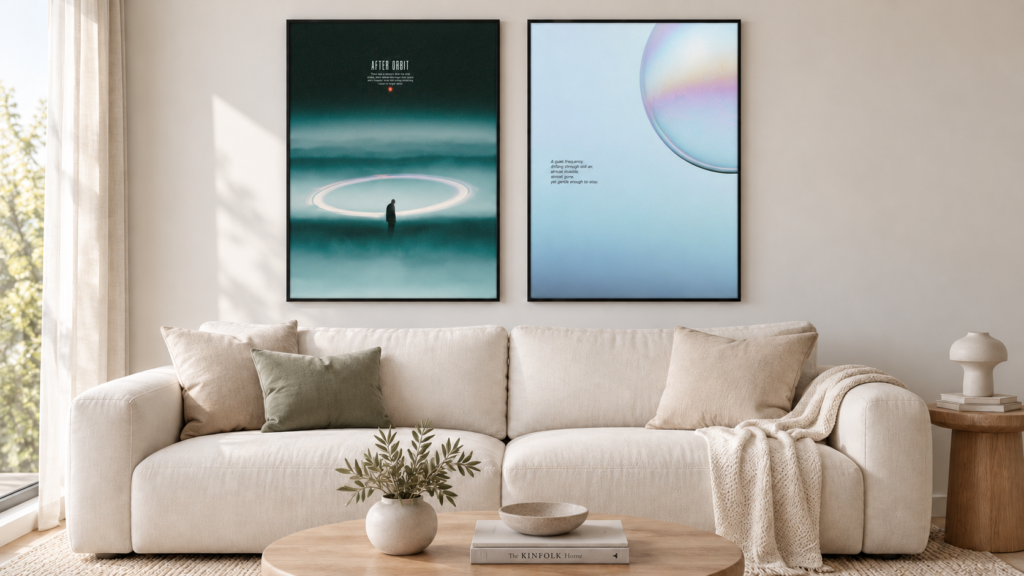
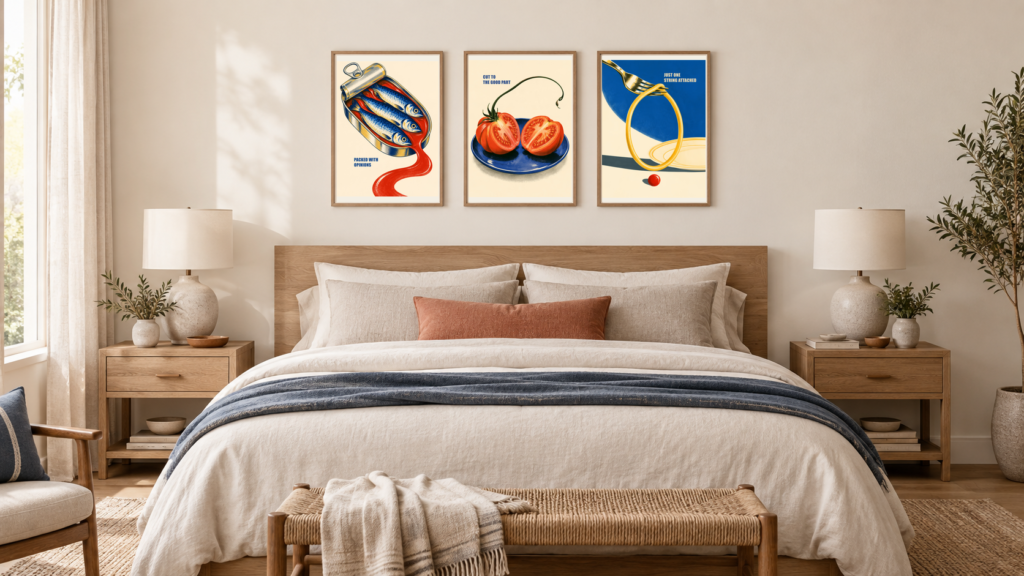
You can also use several posters together. Two or three smaller pieces can occupy a similar visual area to one large print while creating a more layered look.
Before ordering, it can help to temporarily mark the poster dimensions on your wall with removable tape or a paper template. This gives you a much clearer idea of the real scale than looking at measurements on a screen.
Remember to Include the Frame
Poster dimensions describe the artwork itself, not necessarily the total amount of wall space the finished piece will occupy.
A frame adds extra width and height around the print. A wide frame or mat can make a relatively small poster appear much more substantial once it is displayed.
Keep this in mind when measuring tighter spaces such as:
-
- Between shelves
-
- Beside doors
-
- Above narrow desks
-
- Between windows
-
- Inside an existing gallery wall
If you already know which frame you want to use, measure the complete framed dimensions rather than relying only on the print size.
One Poster or a Gallery Wall?
You do not always need one oversized print to fill a larger space.
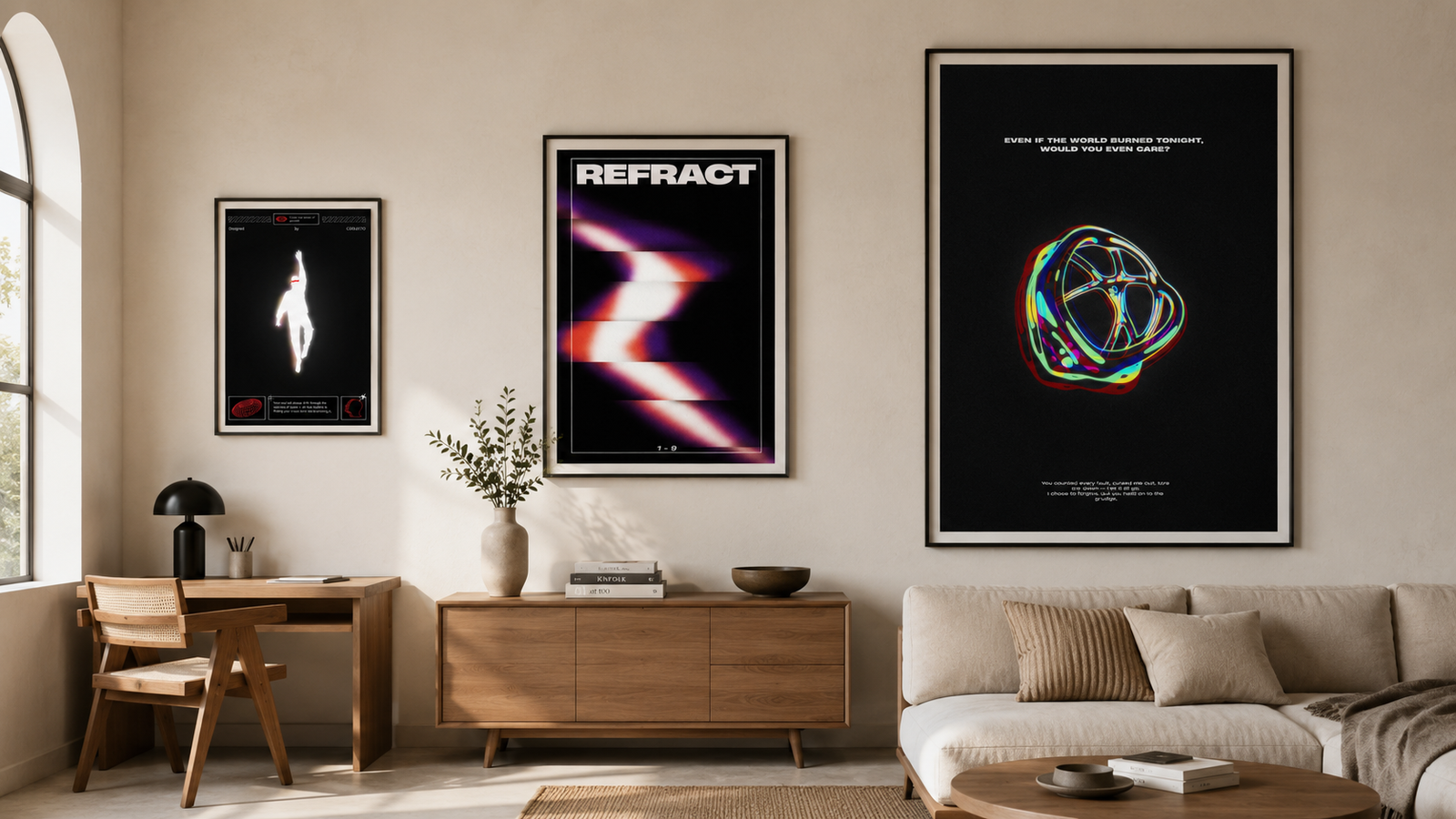
A gallery wall lets you combine different poster sizes and styles to create something more relaxed and collected.
One simple approach is to choose a medium or large poster as the visual anchor, then add two or three smaller prints around it.
For example, you could combine:
-
- One bold typography poster
-
- One abstract design
-
- One smaller colorful illustration
The artwork does not need to be identical in style. Repeating one or two elements, such as color, frame finish, or spacing, can help the collection feel connected.
If you prefer a clean and minimal room, one statement poster may be enough. If you enjoy a more expressive interior, mixing several sizes gives you more freedom to build a wall gradually.
If you are planning to combine several poster sizes, our gallery wall guide explains how to create a balanced arrangement without overcomplicating the layout.
Explore Coolecto posters for colorful typography, modern abstract artwork, playful prints, and designs that can be mixed across a gallery wall.
Consider the Shape of the Wall
Size matters, but proportion matters too.
A tall, narrow section of wall often works naturally with portrait artwork. A wide area above a sofa or cabinet may give you more freedom to use multiple vertical posters side by side.
Pay attention to the shape of the empty space rather than choosing a poster based only on the overall dimensions of the room.
This is especially useful when decorating awkward walls, corners, or spaces interrupted by doors, windows, and shelves.
Check the Size Before You Buy
One of the easiest ways to avoid choosing the wrong poster size is to preview the dimensions directly on your wall.
You can:
-
- Mark the corners with removable tape
-
- Cut paper or cardboard to the poster dimensions
-
- Compare two possible sizes side by side
-
- Step back and view the outline from across the room
-
- Check how the size looks when sitting or standing nearby
Do this with the frame dimensions included if you plan to frame the poster.
A size that sounds large when written in inches can feel surprisingly modest once it is placed on a wide wall, so seeing the dimensions physically can make the decision much easier.
Choose the Size Based on the Feeling You Want
There is no single correct poster size for every bedroom, living room, or office.
Think about what you want the artwork to do.
Choose a smaller poster if you want a subtle decorative accent.
Choose a medium poster if you want something versatile that can work alone or within a gallery wall.
Choose a larger poster if you want the artwork to become one of the first things you notice when entering the room.
Poster sizing guidelines are useful, but your space does not need to follow a rigid formula. Sometimes a small print surrounded by negative space feels more interesting than a large piece. In another room, a bold oversized design may be exactly what an empty wall needs.
Frequently Asked Questions About Poster Sizes
What poster size is best for a bedroom?
Small and medium posters work well around bedside tables, desks, and smaller walls, while larger prints can create a focal point above a bed or dresser. The best size depends on the available wall space and surrounding furniture.
For more inspiration, explore our bedroom poster ideas for modern spaces.
Is 18 × 24 inches a large poster?
An 18 × 24 inch print offers noticeably more visual presence than smaller poster formats and can work well as a statement piece. On a particularly large wall, it may also be combined with other artwork.
What poster size should I choose for a gallery wall?
Gallery walls usually work best with a mixture of dimensions. Start with one larger or medium anchor piece and arrange smaller posters around it to create balance and variation.
Should my frame be the same size as my poster?
That depends on the frame style. Some frames are designed to fit the print closely, while others use a mat or border. Always check the finished frame dimensions when planning how much wall space the artwork will occupy.
Find the Right Poster Size for Your Space
The best poster size is the one that feels intentional within your room.
Start with the wall, consider the furniture and objects around it, and decide whether you want the artwork to blend into the space or become its main focal point. When you are unsure, preview the dimensions on the wall before making your choice.
Once the scale feels right, the artwork can do the rest.
Discover original colorful typography, modern abstract artwork, playful designs, and wall art created for bedrooms, living rooms, creative spaces, and gallery walls.